AMAZON
Gateway 2.0
Reinforce positive customer behavior and engagement by introducing more personalized, contextually relevant shopping moments within Your Orders.
Timeline Jan – Nov ‘22
Collaborated with product, research, tech, partner teams
Designed for mobile application
Customers Amazon customers with orders placed within the prior 3 months.
Business Goal Empower customers with greater control and a more customized experience, while driving incremental sales through intelligent product recommendations and easier repurchasing.
Constraints Scalable solutions that aligned with Amazon’s existing page frameworks and avoided tech debt
Research and Discovery
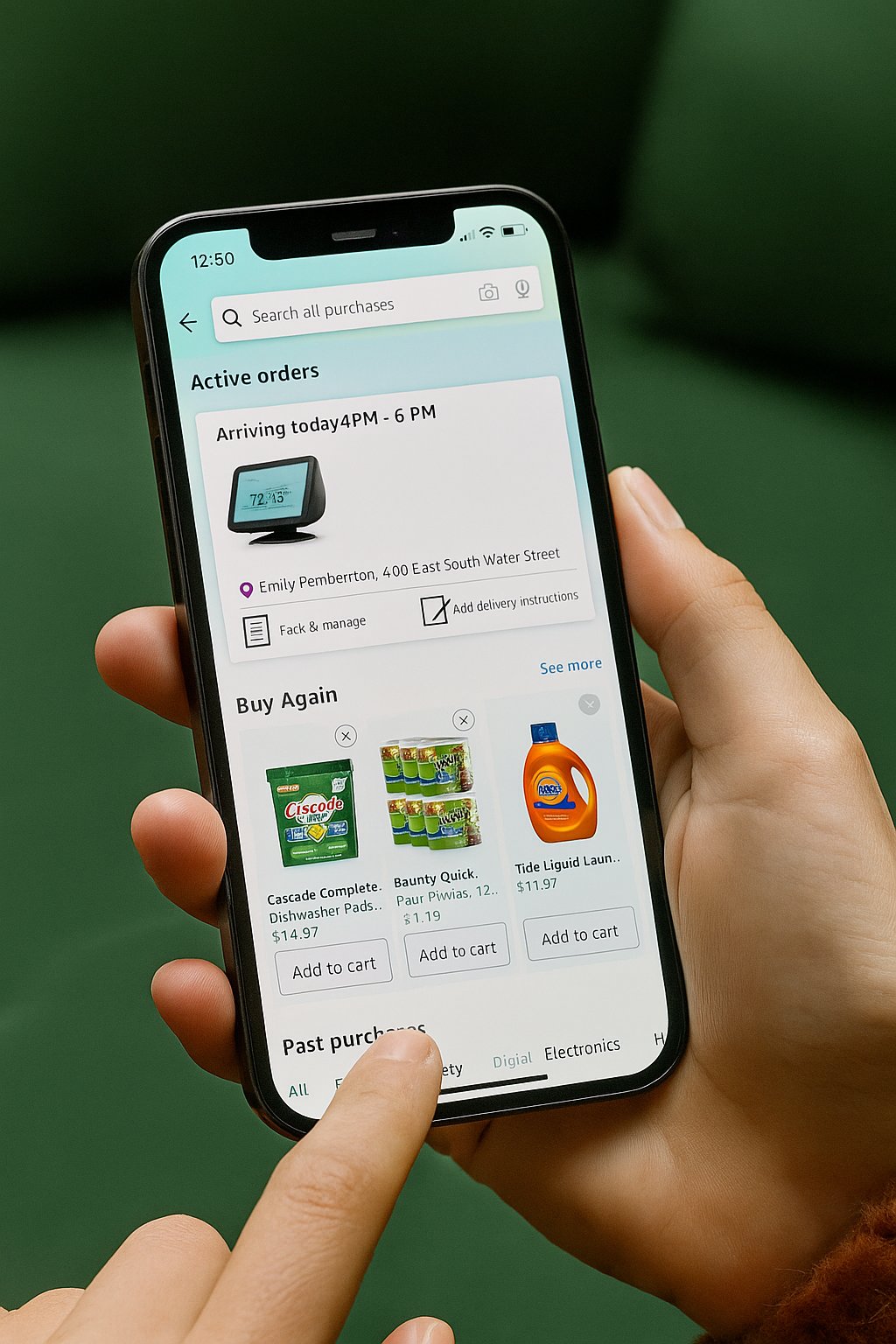
I conducted heuristic reviews, analyzed behavioral data, and interviewed frequent shoppers to understand how customers interacted with Your Orders. Insights revealed that while users trusted the page for reliability, they rarely saw it as a place for inspiration or discovery. This created a clear opportunity to surface personalized, trust-based recommendations in a familiar context.
Design Opportunities
Introduce contextually relevant product suggestions based on previous orders and browsing patterns. Optimize placement and visibility of key actions, incorporating real-time pricing and availability to reduce friction.
Allow customers to refine future recommendations and improve machine learning accuracy.
Showcase other Amazon programs and features to provide more visibility into under-utilized benefits.
Process
Navigating Ambiguity When Gateway 2.0 began, the problem statement was intentionally broad: make “Your Orders” more engaging. It wasn’t clear whether “engagement” meant increasing page visits, improving repeat purchases, or simply reinforcing trust in post-purchase experiences.
To uncover where to focus, I facilitated a working session with product and partner teams to map existing hypotheses against behavioral data. Through this process, we realized that customers were already relying on Your Orders as a utility page, but not as a place for ongoing discovery. The opportunity wasn’t to redesign the page, but to redefine its role. My designs transformed a static list of transactions into a personalized, habit-reinforcing touchpoint within the customer’s shopping lifecycle.
Brainstorming Partnered across disciplines to identify opportunity areas, prioritizing based on customer impact, technical feasibility, and roadmap alignment.
Iteration Used customer feedback to refine navigation patterns and ensure accessibility compliance.
Integration Collaborated with engineering and ML teams to embed personalization models directly into the experience. Coordinated with Advertising and Buy It Again teams to align placements and ensure a cohesive ecosystem.
Phased Rollout Released features incrementally to measure customer behavior in live environments and inform future iterations.
Collaboration
The project required alignment across multiple orgs, each with distinct success metrics and technical dependencies. I collaborated closely with PMs and ML engineers to understand how recommendation models could be safely surfaced in a high-trust environment. In parallel, I worked with teams such as Advertising and Buy It Again to align placements and avoid competing moments of attention.
Because decision-making spanned several product groups, I introduced lightweight async reviews and visual decision logs to create shared visibility. This approach helped us move faster across time zones while documenting trade-offs, ensuring that design choices reflected both customer experience and business priorities.
Below is an sample of the organizations that I partnered with.
A | Buy it Again
B | Grocery and Digital
C | Program owners: Prime, Alexa, Climate Pledge
D | Fashion
E | Advertising
F | Core Retail
Design Explorations
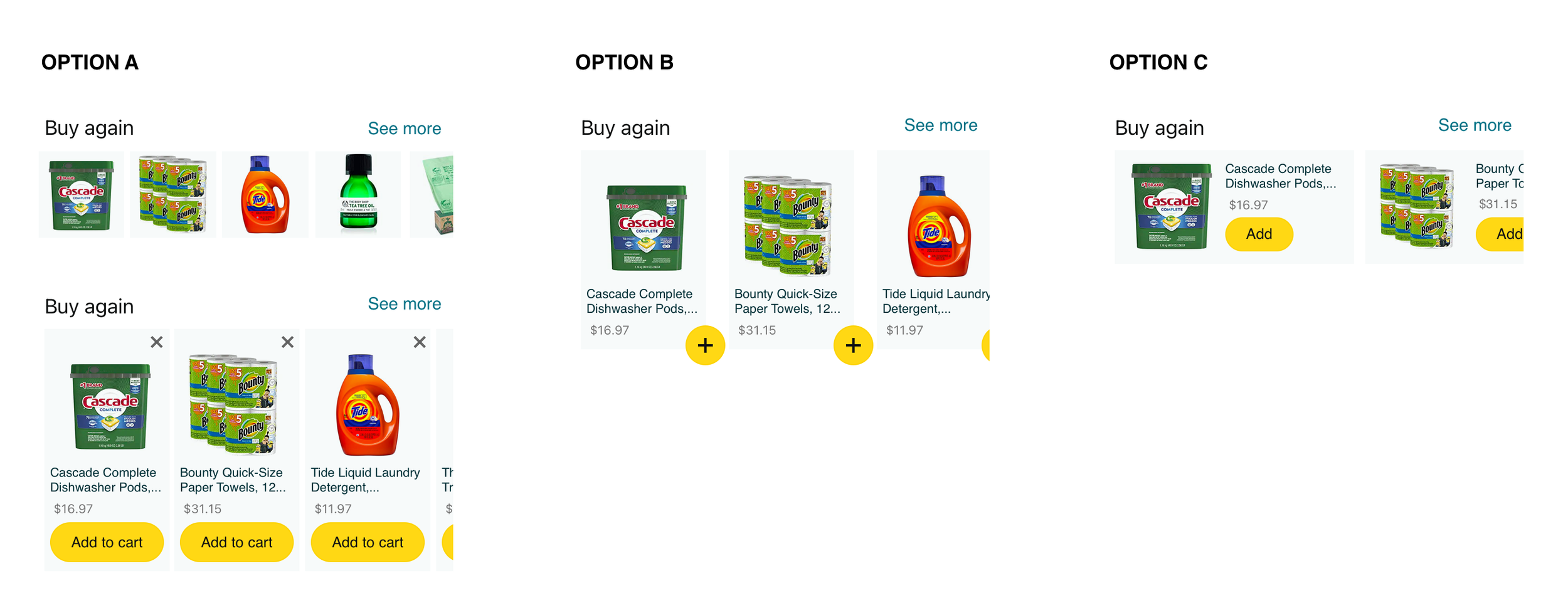
Much of the exploration centered around how to introduce personalization through lightweight, intuitive interactions that fit naturally into familiar Amazon behaviors. I explored a range of concepts focused on Buy It Again and post-purchase actions. I tested different ways customers might engage with past purchases without adding friction to the core flow.
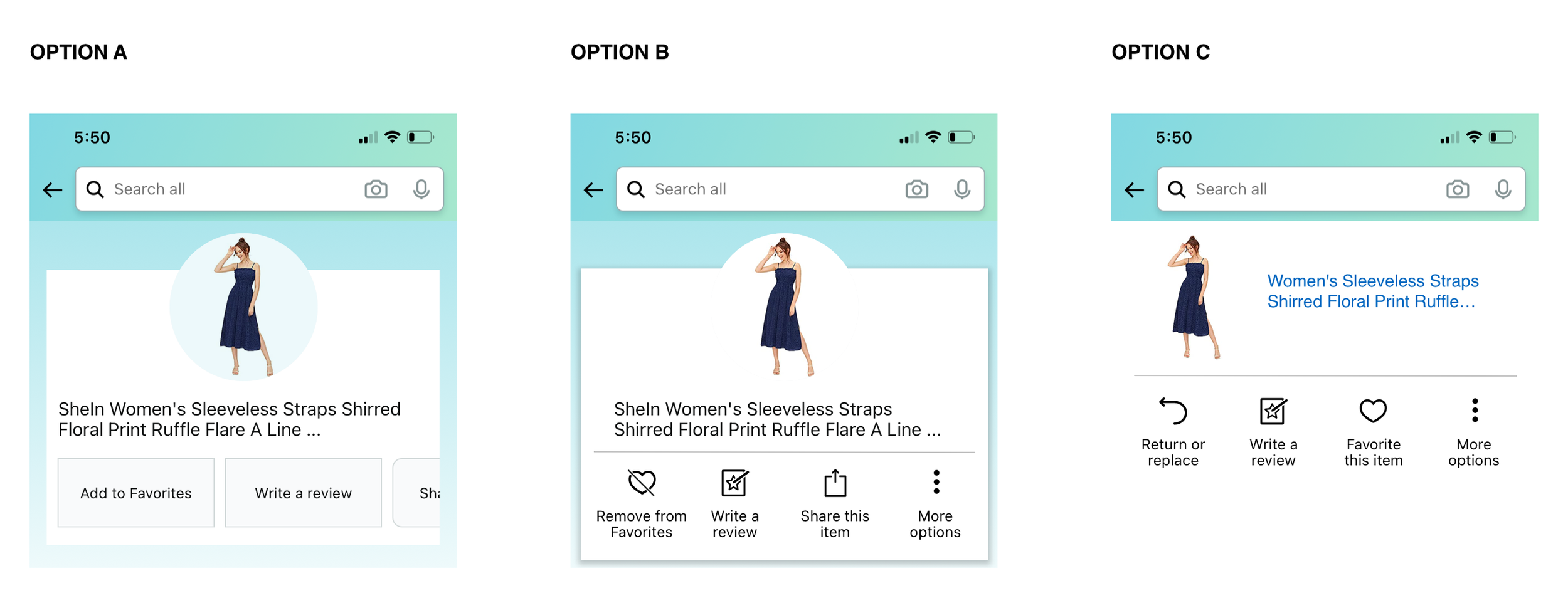
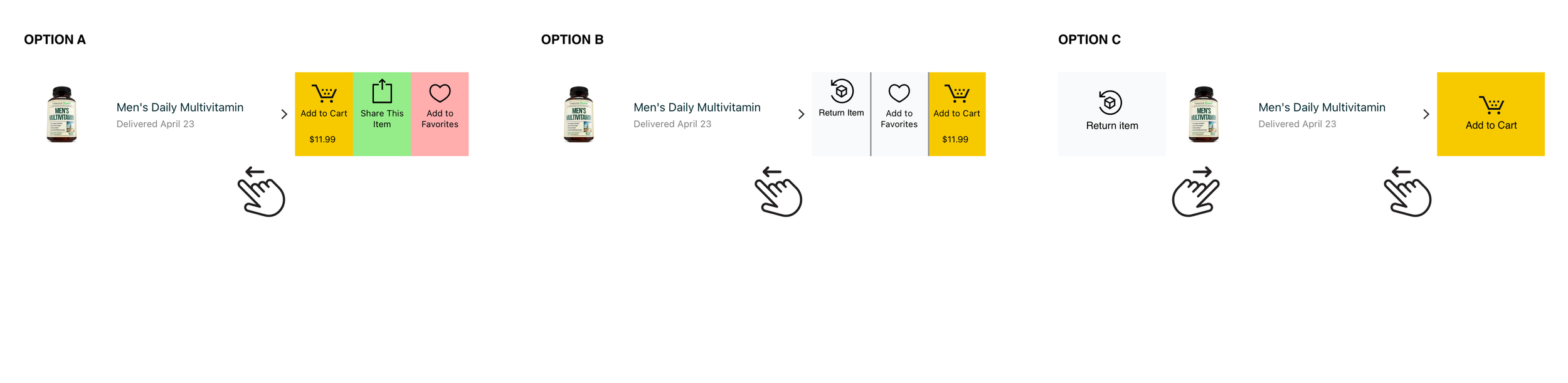
Some prototypes introduced swipe gestures on past orders to quickly reveal controls like Reorder, Save to Favorites, and Share. Others experimented with contextual micro-interactions within the Product Detail Page, allowing customers to perform similar actions directly at the source of the purchase. These variations helped uncover how subtle, anticipatory interactions could encourage repurchasing now while also training the system for future personalization.
Through multiple rounds of feedback and internal testing, I refined these interactions to feel assistive rather than intrusive. The resulting design not only improved usability but also created richer behavioral signals for Amazon’s machine learning models, enabling smarter and more contextually relevant recommendations over time.
Final Solution and Impact
Solution
• Introduced dynamic personalization through modular recommendations widgets and clearer repurchase actions.
• Added contextually relevant recommendations, faster access to repurchasing, and subtle feedback tools that continuously refine personalization.
• The new experience reframed a purely functional page into one that encourages discovery and repeat purchasing.
Impact
• Qualitative feedback and internal reviews highlighted that customers found the experience more helpful, efficient, and aligned with their shopping habits.
• The phased rollout also provided a framework for testing personalization in other post-purchase contexts, influencing roadmap priorities across adjacent teams.
• Set a foundation for scalable personalization patterns adopted across Amazon’s broader order management ecosystem.
Reflection
Gateway 2.0 reinforced the importance of embracing ambiguity early and using collaboration as a tool for clarity. By framing design not as a set of screens but as an ecosystem of personalized decisions, the project established a scalable foundation for future personalization patterns within Amazon’s order management experience.